Sleep Apnoea: 2024 Research

Sep 11 / Small Steps Editor

Obstructive sleep apnoea (OSA) is far more common in infants and toddlers with Down syndrome than many parents or caregivers realize — and early detection can make a big difference.

Recent studies (2024-2025) show extremely high rates of OSA in very young children with DS, prompting renewed recommendations for early screening.

Below, we've tried to summarize everything you should know — what to look out for, what the diagnostic process is like, and what to ask your child’s doctor.

What the Latest Data Shows

  • A recent 2024 study on a group of infants/toddlers with Down Syndrome, found that over 90% of the group had Obstructive Sleep Apnoea (OSA) even in their first year of life. (PMC)
  • In preschool age (2-4 years), nearly all children with DS referred for sleep studies had OSA; only about 5% did not have the condition. (Paediatrics)
  • The severity of OSA in these young children is also often high, with many showing moderate to severe obstruction and, in some cases, accompanying nocturnal hypoventilation or airway compromise. (Paediatrics)

Because Down Syndrome carries multiple anatomical and physiological risk factors (for example, low muscle tone, narrow airway, large tongue, enlarged tonsils/adenoids, etc.), infants and toddlers are especially vulnerable. (MDPI)

Subtle Signs of OSA in Infants & Toddlers with Down Syndrome

Many classic symptoms (e.g. loud snoring) may or may not be obvious; often the signs are subtle, especially in very young children.

Here are some signs to watch for:
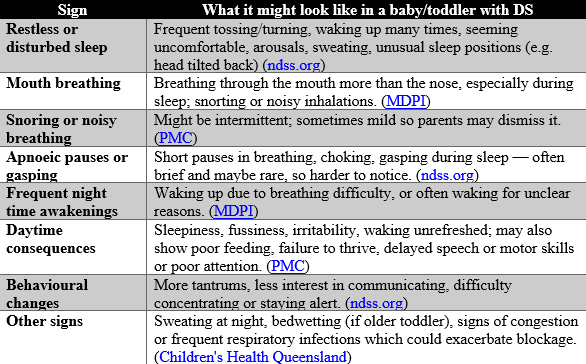
Because many of these symptoms overlap with typical DS issues (low tone, respiratory infections, feeding challenges, etc.), it's easy to miss or under-estimate OSA. That’s why screening or formal evaluation is so important.

What a Sleep Study (Polysomnogram) Involves

If your paediatrician thinks there may be OSA (or as part of routine monitoring for DS), they may recommend a sleep study.

Here's what you can expect:

  • Overnight testing: The child sleeps in a sleep lab (hospital or clinic) overnight, though sometimes home sleep studies may be used depending on availability and tolerability. (ndss.org)

  • Sensors: The child will wear sensors that monitor:
  • Brain activity (EEG) to determine sleep stages
  • Eye movements
  • Muscle tone
  • Breathing patterns (airflow in nose/mouth, effort of chest and abdomen)
  • Oxygen saturation in the blood Carbon dioxide levels (in some studies, to detect hypoventilation) (Paediatrics)
  • Heart rate Snoring / sound / position of body (Paediatrics)


What’s measured / outcomes:


  • Apnoea-Hypopnea Index (AHI): number of obstructive events per hour of sleep.
  • Severity (mild/moderate/severe) based on AHI, oxygen drops, CO₂ retention.
  • Sleep fragmentation: how often sleep is disrupted. Duration of low oxygen or elevated CO₂.
  • Sometimes positional effects: e.g. more obstruction when lying on back vs side. (Pediatrics)

After the study:
  • Results are reviewed with you; may lead to treatment options (surgery, CPAP, etc.). Also, follow-ups or repeated studies may be needed, especially if treatment is done. (Paediatrics)

Questions to Ask Your Paediatrician

To make sure you have a thorough conversation and don’t miss anything, here are useful questions:

  • When should we screen for OSA in my child with DS? (E.g., “Do you recommend a sleep study by age 6 months? By 1 year? By 2 years?”)
  • Do you think my child is showing any of the subtle signs of OSA? (Bring your observations: snoring, restless sleep, feeding problems, behaviour.)
  • If we do a sleep study, is there a centre near us experienced with children with DS?
  • What kind of sleep study would you recommend? (Full in-lab PSG vs home monitoring vs shorter overnight studies.)
  • What are the risks if OSA is untreated in young children with DS? (Includes effects on growth, heart, development, cognition, etc.)
  • If OSA is diagnosed, what treatment options might be considered? (E.g., surgery (adenotonsillectomy), CPAP/BiPAP, positional therapy, etc.)
  • How will treatment success be evaluated? Do we repeat the sleep study?
  • Are there non-surgical options or conservative measures that might help? (For example managing congestion, reflux, sleep positioning, weight if relevant.)
  • What are potential side-effects or challenges of treatment (e.g. CPAP mask fit, surgery risks)?
  • Are there developmental or behavioural supports to help if OSA is affecting learning, attention, or speech?


Action Steps & Take-Home Message


If your child has Down syndrome, don’t wait for obvious snoring or breathing pauses. Because the prevalence of OSA is very high even in infants and toddlers, early screening is recommended. (PMC)

 Keep track of sleep behaviour and any of the subtle signs listed above; make notes, even video/audio if feasible, to share with your doctor. Advocate for a sleep study if there are concerns, even if symptoms seem mild. Early diagnosis and treatment can improve quality of life: better sleep, better heart health, better attention, enhanced growth and developmental outcomes.  

For Parents and Parents-to-Be of Children with Down Syndrome

Discover everything you need to know in one free platform, including:

- Clear, easy-to-read guides and flyers
- Early intervention modules to support your child’s development
- Baby sign language and other practical tools
- A supportive online parent community
- Blog articles and stories from other families
Shott, S. R., Amin, R., Gozal, D., Skotko, B. G., Chawla, J., & Bhattacharjee, R. (2024). Very early onset of obstructive sleep apnea in infants with Down syndrome: Prevalence and clinical implications. Journal of Pediatric Sleep Medicine, 3(4), 100–112. https://doi.org/10.1016/j.pedss.2024.100202
Disclaimer: The information provided on Small Steps Online is for educational purposes only and is not a substitute for professional medical, therapeutic, or developmental advice. Always consult with qualified healthcare providers, therapists, or relevant professionals regarding your child’s specific needs and situation. The September Institute and Small Steps Online are not liable for any outcomes resulting from the use or misuse of the information shared here.
Created with