What the Research Tells Us
The study, conducted by Baumer and colleagues at Boston Children's Hospital, collected data from 842 children with Down syndrome (ages 2 months to 24 years) attending their Down Syndrome Program (PubMed). By analysing when children reached 25 specific developmental milestones across language, motor, adaptive, and academic domains, they estimated the ages by which 75% of children with Down syndrome typically achieved each milestone.
These benchmarks allow paediatricians and parents to see realistic expectations—for example, first meaningful words, standing independently, or self-feeding—on a Down syndrome–specific timeline.
Reframing Milestones with Kindness
The study, conducted by Baumer and colleagues at Boston Children's Hospital, collected data from 842 children with Down syndrome (ages 2 months to 24 years) attending their Down Syndrome Program (PubMed). By analysing when children reached 25 specific developmental milestones across language, motor, adaptive, and academic domains, they estimated the ages by which 75% of children with Down syndrome typically achieved each milestone.
These benchmarks allow paediatricians and parents to see realistic expectations—for example, first meaningful words, standing independently, or self-feeding—on a Down syndrome–specific timeline.
Reframing Milestones with Kindness
- Milestones arrive in their own time. Your child is not behind—they’re just following a different rhythm.
- Every skill is valuable. Reaching, babbling, or understanding are foundational steps toward future achievements.
- Comparisons don’t help. Let your child’s personal progress be the guide—and celebrate this unique journey.
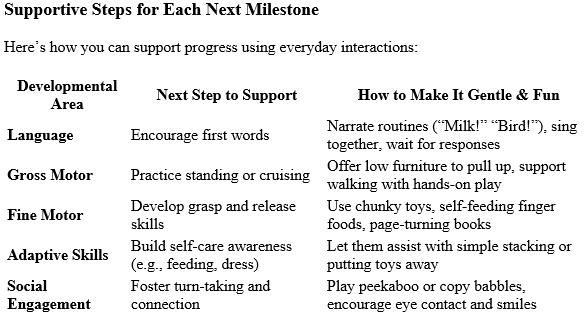
For Parents and Parents-to-Be of Children with Down Syndrome
References:
Baumer, N., DePillis, R., Pawlowski, K., Zhang, B., &
Mazumdar, M. (2024). Developmental Milestones for Children With Down
Syndrome. Pediatrics, 154(4): e2023065402. https://doi.org/10.1542/peds.2023-065402
(PubMed)
Disclaimer: The information provided on Small Steps Online is for educational purposes only and is not a substitute for professional medical, therapeutic, or developmental advice. Always consult with qualified healthcare providers, therapists, or relevant professionals regarding your child’s specific needs and situation. The September Institute and Small Steps Online are not liable for any outcomes resulting from the use or misuse of the information shared here.
Created with